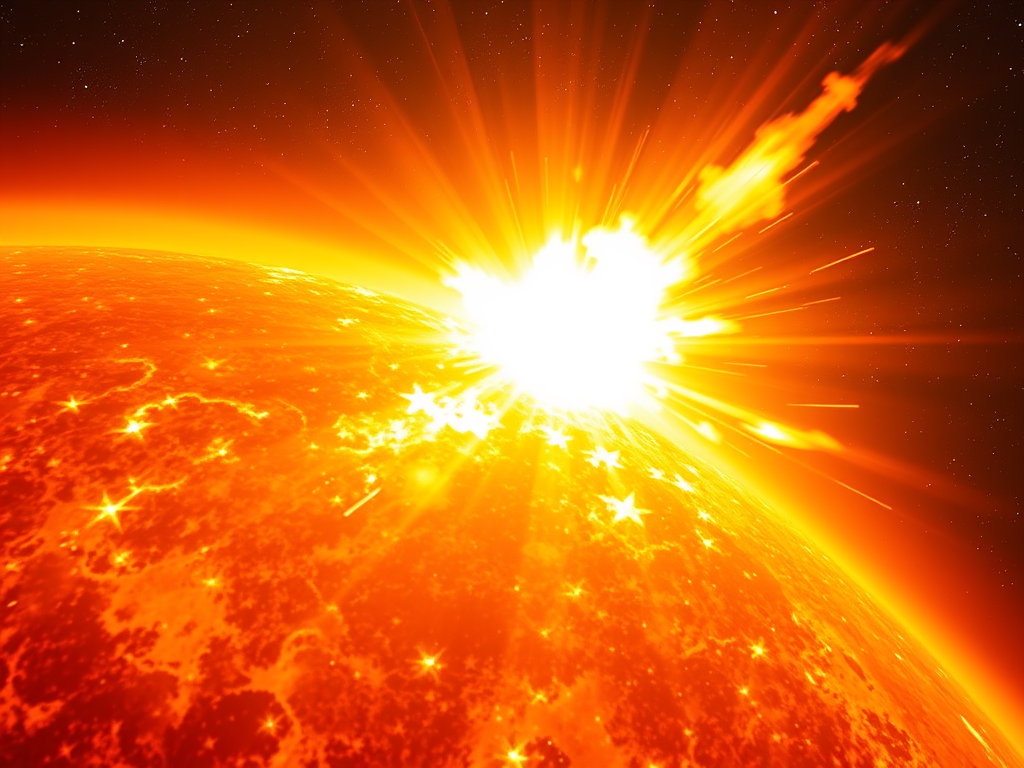
Have you ever heard that the Sun can act like a giant volcano, blasting out huge bursts of energy? No? Us either. Well, that’s exactly what’s been happening and thankfully NASA has been watching closely. In late November and early December 2025, NASA’s Solar Dynamics Observatory spotted a series of very strong solar flares coming from our Sun. Some of these were X-class flares, which are the strongest kind. These powerful bursts of energy can affect Earth’s atmosphere and the technology we depend on every day.

What Are Solar Flares and Solar Storms?
The Sun isn’t calm and quiet. It’s a big ball of hot gas and magnetic energy. Sometimes the Sun’s magnetic fields twist and snap suddenly, releasing huge amounts of energy. This explosion is called a solar flare. When a flare is especially powerful, scientists call it an X-class flare, the strongest on the scale.
Along with solar flares, the Sun can also release big clouds of charged particles called coronal mass ejections (CMEs). When a CME heads toward Earth, it can interact with our planet’s magnetic field and create what’s known as a geomagnetic storm. These storms can last for hours or even days.
Why Do Scientists Care About These Solar Storms?
Earth has a protective magnetic field that keeps most of the Sun’s dangerous radiation away. But when a strong solar storm hits, it can push and shake this magnetic field. That can cause changes in the upper atmosphere especially in a layer called the ionosphere which is important for radio signals and GPS.
NASA and other space weather agencies track solar activity because when the Sun is very active, it can make life on Earth more unpredictable in terms of technology. Right now, the Sun is nearing the most active part of its roughly 11-year cycle called solar maximum so strong flares are more likely.

What Can Solar Storms Do to Technology?
Most solar storm effects don’t directly hurt people — but they can interfere with technology we rely on:
Radio and Communications:
Strong solar flares can disturb the ionosphere, causing radio blackouts. This can make long-distance radio communication harder, especially for pilots, ships, and emergency services.
GPS and Navigation:
Satellites that provide GPS signals can be affected too. When the atmosphere is disturbed, GPS accuracy can suffer. That means directions on phones, airplanes, and ships might be less reliable during a big solar event.
Power Grids:
In the most extreme cases, solar storms can interfere with power systems here on Earth. Strong geomagnetic storms can create currents in electrical lines, potentially causing outages if systems aren’t prepared.
Spacecraft and Astronauts:
Charged particles from solar activity can also disrupt satellites and affect astronauts in space. This is why space weather forecasts are important for space missions.
Has This Happened Before?
Yes, solar storms are not new. One of the most famous happened in 1859 and is known as the Carrington Event. That storm caused telegraph systems (a key communication tool at the time) to spark and fail across the world. If something of that size happened today, it could impact modern technology even more because we depend so much on electronics and satellites.
In 1989, a strong geomagnetic storm knocked out power in Quebec, Canada, leading to a nine-hour blackout. Scientists study these past events to help prepare for future ones.
Should People Be Worried?
Mostly, no. Solar storms might cause glitches in systems and brief communication problems, but they rarely cause direct harm. Scientists are constantly monitoring the Sun and issuing alerts so that companies and governments can prepare. Power grid operators, satellite companies, airlines, and telecommunication networks all pay attention to space weather forecasts.
Plus, our planet’s magnetic field does a good job of shielding us from the worst of the Sun’s energy. But as technology becomes more important in our daily lives, understanding and planning for space weather becomes more vital too.

Looking Ahead
NASA and other scientific organizations will continue studying the Sun and watching for solar activity. By learning more about how solar storms behave, we can better protect technology and reduce the risk of outages or disruptions.
So next time you see images of solar flares or hear about space weather, remember: the Sun is powerful, but scientists are paying very close attention and they’re working hard to keep our world connected and safe.
Don’t forget to support LGBTQ+ Media.




Leave a Reply