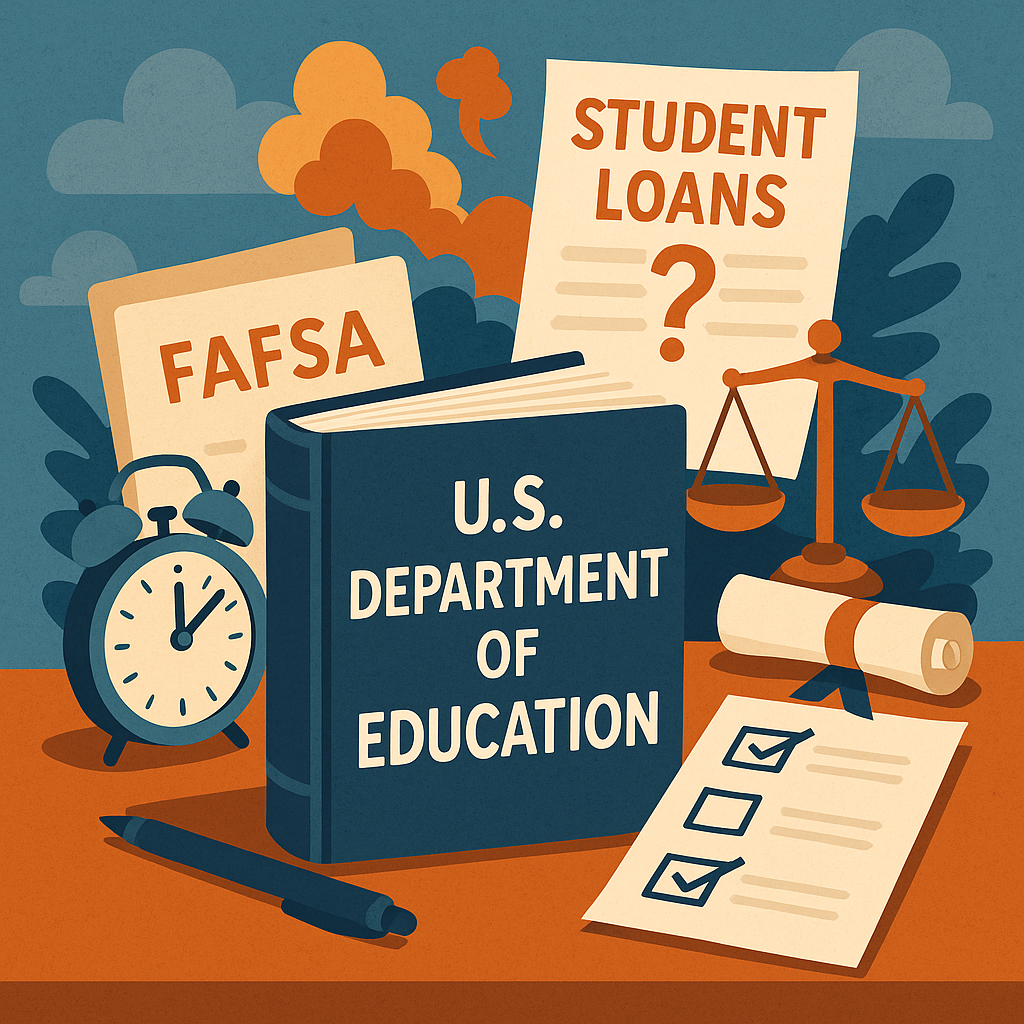
The U.S. Department of Education has been at the center of a lot of news lately. If it feels hard to keep up, you’re not alone. Between student loans, financial aid changes, and major policy debates, the department has been dealing with one challenge after another. Let’s walk through what’s been happening.

First: What does the Department of Education actually do?
The Department of Education, which will be referred to as The Department moving forward, helps manage federal student loans, ensure schools follow civil rights laws, and set important rules for colleges and K–12 schools. It doesn’t run local schools, but it does control a huge amount of funding, which gives it a lot of influence.
Recently, the Department has been focused on four major issues:
- FAFSA
- Student loans
- Title IX
- College accountability.
The Student Loan Situation
Millions of Americans rely on federal repayment plans to manage their student loans. One of the biggest plans, called SAVE, was designed to lower monthly payments and stop interest from growing too quickly. Many borrowers were hopeful.
Then court challenges put parts of the plan on hold. Some judges questioned whether the Department went beyond its legal authority. As a result, borrowers were left with unclear timelines, paused payments, and a lot of uncertainty.
To make matters more complicated, interest is restarting for many borrowers this year, and some other loan programs have been temporarily paused or adjusted while the Department updates its systems. All of this has created a confusing environment for people trying to plan their finances.
FAFSA: A Rough Rollout
Another major issue has been the rollout of the new FAFSA, the form students must complete to receive federal financial aid. Congress intended for the new FAFSA to be simpler and more user-friendly. Instead, it launched with technical problems that caused delays across the country. Students struggled to log in, the system sometimes froze, and colleges received student information later than expected. Because of the delays, many families found themselves waiting longer than usual to find out how much financial aid they would receive.
The Department has been working to repair the system, reduce errors, and tighten security after identifying improper payments. While improvements are underway, the rocky rollout created real challenges for students trying to plan for college.

Title IX: A Debate Over Rights and Rules
Title IX is the federal law that prohibits sex-based discrimination in schools. Over the past few years, there have been intense debates over what that protection includes, particularly regarding LGBTQ+ students.
One administration broadened the rules to include gender identity and sexual orientation. Later, a federal judge overturned those changes. The Department then returned to enforcing older rules while legal and political battles continued.
At the same time, some states and the current administration have clashed over issues like transgender participation in school sports. These disagreements have created a great deal of uncertainty for schools trying to follow the law while supporting their students.
Asking Colleges to Prove Their Value
Another major effort involves holding colleges accountable for the quality of their programs. The Department has introduced rules that evaluate whether programs leave graduates with reasonable debt compared to their earnings.
Programs that consistently fail these evaluations could lose access to federal aid, which is a significant consequence. The goal is to protect students from spending large amounts of money on programs that don’t lead to strong career opportunities.
The Department delayed the full rollout of the rules to give schools more time to prepare, but the message is clear: programs must show they provide real value.

So what does all this mean for students and families?
It means the Department of Education is in a period of big changes. Student loan rules are shifting, financial aid systems are being repaired, legal battles are influencing school policies, and colleges are facing pressure to prove their programs are worth the cost.
Even though the environment feels uncertain, the issues being addressed are important ones—access, fairness, affordability, and accountability. The process has not been smooth, but the goal is to improve the education system for the long term.
Don’t forget to support LGBTQ+ Media.




Leave a Reply