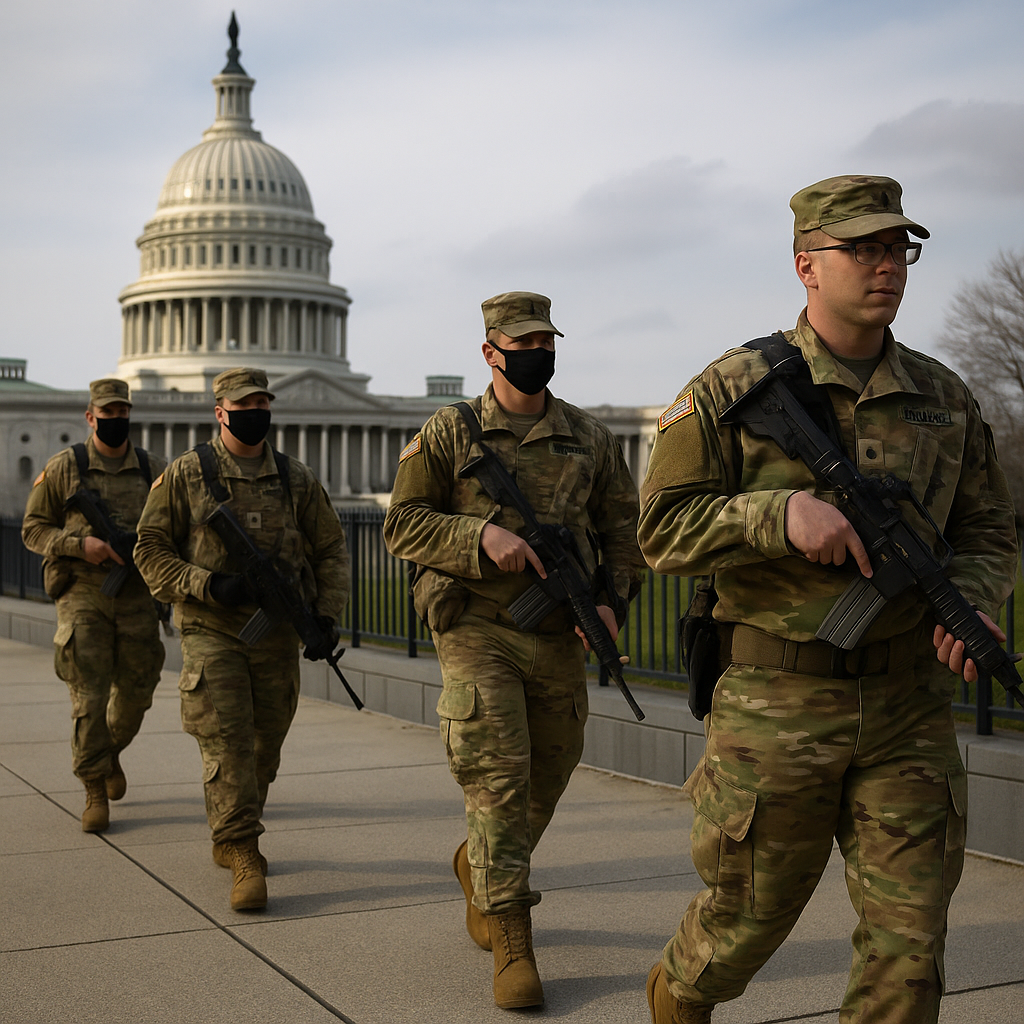
In August, President Donald Trump made one of the most controversial moves of his presidency: invoking Section 740 of the Home Rule Act to seize control of Washington, D.C.’s Metropolitan Police Department and flood the city with National Guard troops. It marked the first time in modern history that a U.S. president bypassed local governance to enforce security in the nation’s capital, raising fundamental questions about democracy, federalism, and the role of the military in civil life.
A Crisis Without a Crisis?
Trump justified his actions by declaring a “crime emergency.” Yet crime data told a different story. According to official statistics, violent crime in Washington was already at a 30-year low, with incidents of burglary, robbery, and car theft trending downward months before the deployment. Within the first weeks of the Guard’s arrival, crime did fall further—violent incidents reportedly dropped by 50 percent compared to the same period in 2024. Still, analysts argue the decline may have been part of an existing trajectory rather than the result of armed patrols.
Boots on the Ground
At the peak of the deployment, more than 2,200 troops from D.C. and Republican-led states such as Georgia, Mississippi, and Louisiana patrolled the city. National Guard members could be found on the National Mall, near the Capitol, and in tourist-heavy zones, projecting strength for visitors and residents alike. Yet in neighborhoods like Anacostia, where residents have long demanded real investment in community safety, the federal presence was less visible. Critics accused Trump of staging a political spectacle rather than addressing the city’s deepest needs.
A Divided Public Response
The community response was swift and polarized. Protests erupted under the banner “We Are All D.C.”, bringing thousands into the streets to denounce what many called an unconstitutional occupation. Signs read “Military Out, Communities In,” highlighting the fear that Guard deployments blurred the line between law enforcement and martial control. Meanwhile, some business owners downtown praised the show of force, claiming it reassured tourists and customers wary of visiting the city.
Legal Challenges in Motion
D.C. Attorney General Brian Schwalb filed suit against the federal government, arguing the deployment violated the Posse Comitatus Act, which prohibits military forces from carrying out domestic law enforcement without congressional approval. Schwalb called the situation an “involuntary military occupation” that undermines the principles of the Home Rule Act, the very legislation that granted D.C. limited autonomy in 1973. Legal scholars also noted that a California court had recently ruled a similar deployment unconstitutional, potentially strengthening D.C.’s case.
A Ripple Across the Nation
Trump signaled his intention to expand this approach to other Democratic-led cities, including Chicago and New York, further fueling fears of federal overreach. Georgia Governor Brian Kemp has already sent 316 National Guard troops to support the D.C. mission, reflecting the partisan split over the initiative. At the same time, the surge in military mobilizations has led to the highest rate of Guard-related worker absences in nearly two decades, highlighting economic and social strains far beyond the capital.
Beyond D.C.: The Deeper Questions
The presence of soldiers on civilian streets invites uncomfortable reflections. Does enhanced security justify the erosion of local governance? At what point does a temporary emergency become a permanent precedent for executive overreach? For some, the deployment symbolizes strength and order. For others, it marks the steady normalization of military force in spaces reserved for civilian authority.
Trump’s gamble in Washington, D.C. may have reduced short-term crime, but the long-term consequences remain murky. Whether this strategy is remembered as a bold stroke of leadership or a dangerous slide into authoritarianism will depend on how history judges the balance between safety, liberty, and the rule of law.




Leave a Reply