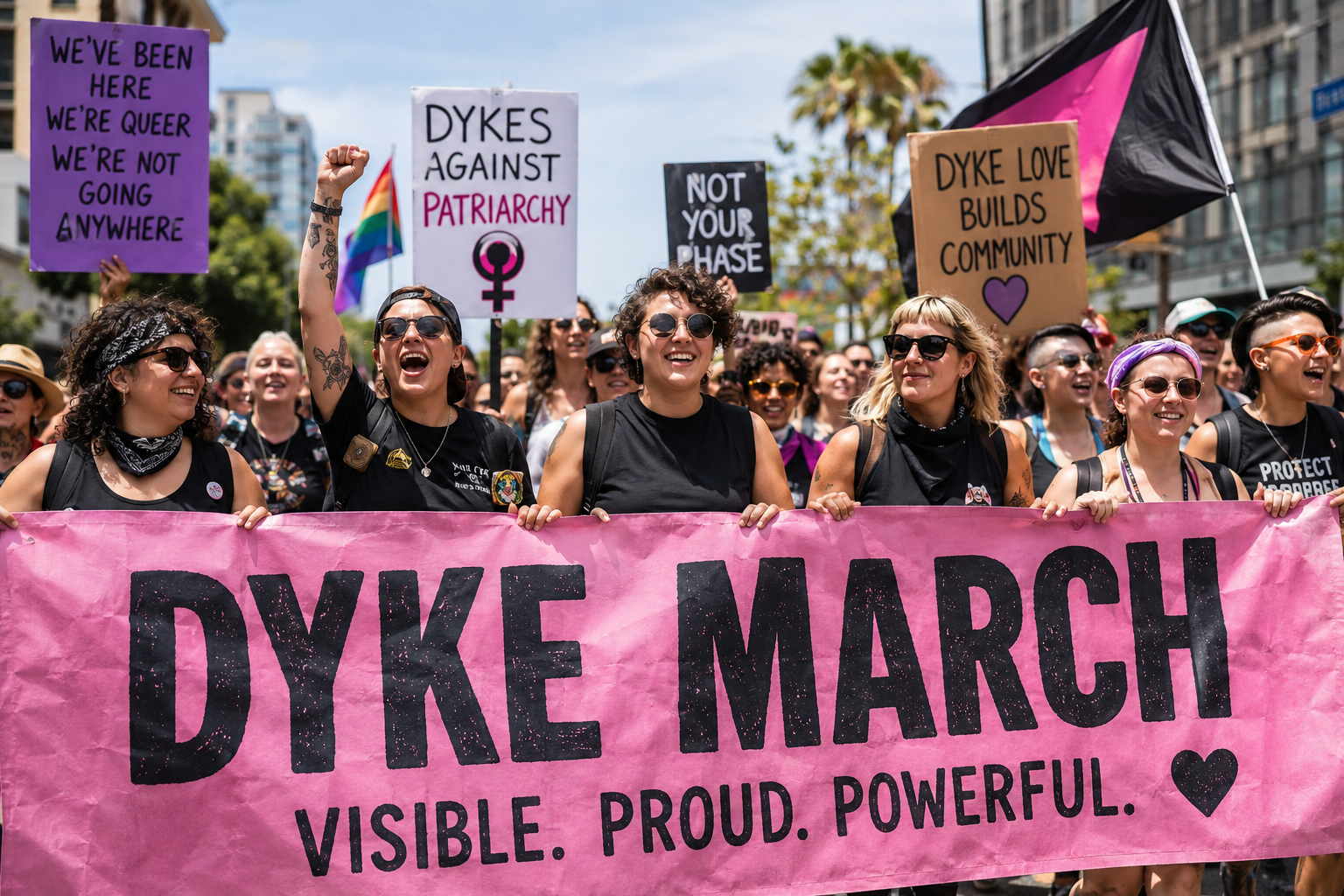
For many people, Pride means rainbow flags, floats, music, and celebration. But for lesbians, there’s another tradition that has carried a different kind of energy for more than three decades: the Dyke March.

As cities across the country continue to revive and expand these marches—including San Diego, where thousands are expected to participate this year—the event remains one of the most powerful symbols of lesbian visibility, activism, and community. While the atmosphere is often joyful, the purpose has always been much bigger than throwing a party.
Born From Protest
The first nationally recognized Dyke March took place in Washington, D.C., in April 1993, just before the historic March on Washington for Lesbian, Gay and Bi Equal Rights and Liberation. More than 20,000 lesbians filled the streets carrying handmade signs, chanting, and demanding that lesbian voices no longer be treated as an afterthought within either society or the broader LGBTQ+ movement.
Although lesbian activists had been organizing demonstrations for decades before then, the 1993 march became the blueprint for what would spread to cities across North America.
The message was simple: lesbians deserved to be seen, heard, and represented.
Why Was a Separate March Needed?
Throughout much of LGBTQ+ history, lesbians often found themselves fighting battles on multiple fronts.
Outside the community, they faced discrimination because of their sexual orientation and gender. Inside the LGBTQ+ movement, many felt lesbian issues were frequently overshadowed by broader conversations or dominated by male perspectives.
The Dyke March emerged as a way to center lesbian voices.
Participants wanted space to discuss issues that uniquely affected lesbians, including healthcare, family rights, domestic violence, economic inequality, reproductive freedom, aging, and representation in media and politics.
Rather than waiting for visibility, they created it themselves.
More Than a Celebration
Unlike many Pride parades, most Dyke Marches remain grassroots events.
Many intentionally avoid corporate sponsorships, elaborate floats, or commercial branding. Instead, organizers emphasize community organizing, political advocacy, local artists, mutual aid, and volunteer leadership.
That doesn’t mean they aren’t fun.

Music echoes through the streets. Friends reunite. Families attend together. First-time marchers discover a community they may have never experienced before.
But underneath the celebration is a reminder that progress wasn’t simply handed over—it was fought for.
Reclaiming a Once-Hurtful Word
The word “dyke” has historically been used as a slur against masculine-presenting lesbians and queer women.
For many participants, reclaiming the word is an act of empowerment.
Using it publicly sends a message that shame no longer belongs to those who were targeted by it. Instead, it transforms a word once intended to silence people into one associated with strength, resilience, and pride.
Not every lesbian chooses to use the term personally, and many acknowledge its painful history. Even so, the Dyke March continues to represent a deliberate act of reclaiming language on the community’s own terms.
Why It Still Matters Today
Lesbian visibility remains an ongoing conversation.
Many advocates argue that lesbian stories continue to receive less attention in mainstream media than other LGBTQ+ narratives. Others point to disparities in healthcare research, representation in leadership, and the availability of spaces specifically designed for lesbians.
Events like the Dyke March help keep those conversations alive.
For younger generations, the march offers an opportunity to connect with decades of lesbian history. For longtime activists, it serves as a reminder that each generation inherits both the victories and the unfinished work of those who marched before them.
San Diego Carries the Tradition Forward
The return of San Diego’s Dyke March is part of a broader resurgence of lesbian-centered events in cities across the United States. Organizers describe this year’s march as both a celebration of community and a statement that lesbian leadership remains essential to the broader LGBTQ+ movement.
As thousands prepare to take to the streets, they’ll be participating in more than just another Pride event. They’ll be continuing a tradition rooted in visibility, solidarity, and the belief that every part of the LGBTQ+ community deserves to be seen on its own terms.
More than 30 years after the first national Dyke March, that message still resonates.



Leave a Reply