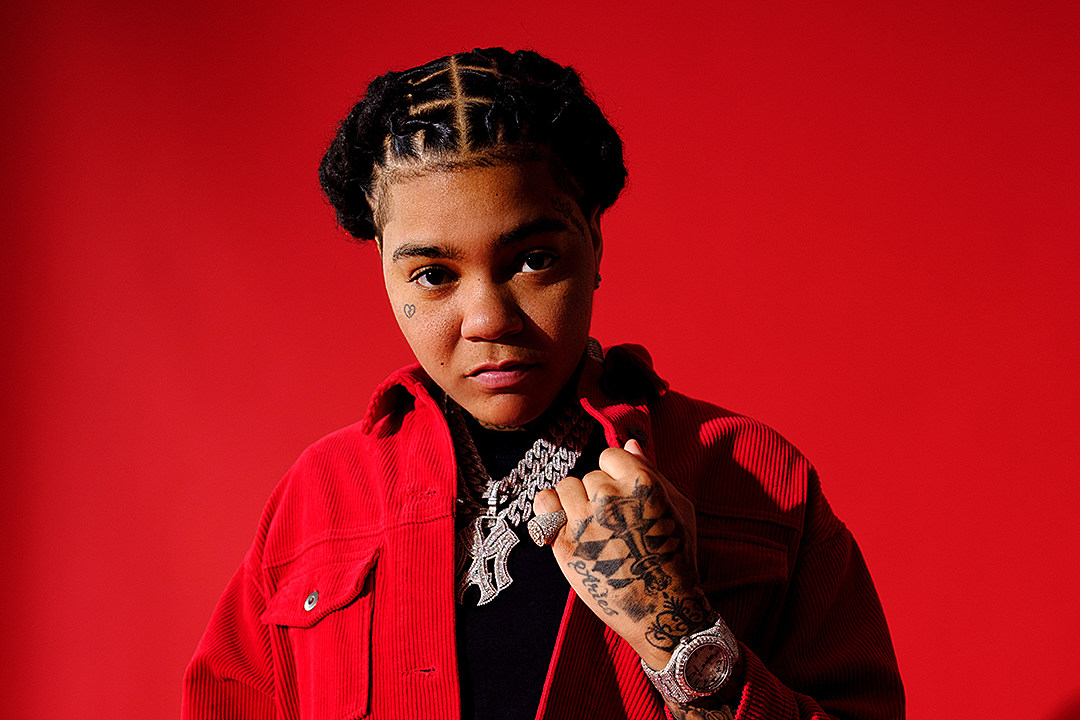
In the summer of 2016, a gritty anthem exploded from the corners of a borough, shaking the foundations of hip-hop with its raw Brooklynite bravado. “OOOUUU” wasn’t just a track—it was a battle cry, a quadruple-platinum juggernaut that catapulted Katorah Kasanova Marrero, better known as Young M.A, from underground cyphers to the Billboard Hot 100’s 19th spot.

With millions of views on YouTube and remixes from heavyweights like Nicki Minaj and French Montana, the song didn’t just go viral; it redefined what a female rapper could command in a male-saturated genre.
But behind the diamond-certified drip lies a story etched in loss, resilience, and quiet rebellion. A tale of a woman who turned personal wreckage into platinum achievements. Young M.A isn’t just a rapper; she’s a survivor who busted doors down in an industry that often bolts them shut.
Born on April 3, 1992, in the heart of East New York, Brooklyn, Marrero entered a world pulsing with the dual rhythms of Jamaican patois from her mother, Latifa, and Puerto Rican fire from her father. Life, however, dealt early blows. When she was just one year old, her father was incarcerated for a decade-long stretch, entangled in the shadows of heroin addiction that would haunt the family. Latifa, a single mother scraping by with long hours at low-wage jobs, shielded her children from the escalating violence tearing through their neighborhood. By the time Marrero was seven, her mother, fearing for their safety amid the crack-era echoes still reverberating in Bed-Stuy, uprooted the family to the quieter suburbs of Chesterfield, Virginia.
There, amid manicured lawns and better schools, young Marrero discovered her first armor: tackle football. As the only girl on her school’s team, she learned to hit hard and stand taller, traits that would later fuel her lyrical assaults.Music became her second skin around age nine, when she’d scribble rhymes in school notebooks, dreaming of escaping the pull of the streets. Latifa, spotting the spark, invested in a karaoke machine, transforming a closet into an impromptu studio. “She saw something in me,” Marrero later reflected, crediting her mother’s unwavering belief as the foundation of her craft.

Marrero fronted a teenage rap group called Moneymakers, honing her flow on local stages. But Virginia’s calm was temporary; at 16, the family returned to New York, plunging her back into the chaos she’d fled. High school at Sheepshead Bay became a grind, graduating in 2010 amid the weight of adolescence in a city that devours the unprepared.Tragedy struck in 2009, just as her dreams solidified. Her older brother, Kenneth Ramos, was stabbed to death on September 26 by a former friend in a senseless act of betrayal. At 17, Marrero spiraled into a month-long haze of grief, skipping school and grappling with depression so profound it silenced her mic. Therapy became her reluctant lifeline, pulling her from the edge. “That loss… it broke me,” she admitted in a raw 2019 interview, describing how the void fueled her music.
From those ashes rose her debut single in 2011, self-recorded in a makeshift setup funded by retail gigs at Shake Shack and T.J. Maxx. Poverty nipped at her heels but hustle was her inheritance.The rise ignited in 2014 with “Brooklyn Chiraq,” a freestyle that lit up YouTube after conservative pundit Boyce Watkins decried it as glorifying violence. Controversy? It was rocket fuel. The track’s unapologetic nod to her roots went viral, drawing 1 million views overnight and positioning her as Brooklyn’s unfiltered voice.
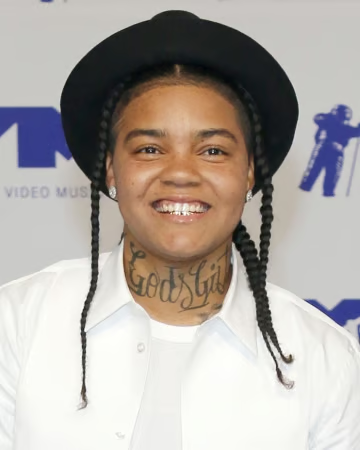
Mixtapes followed: M.A The Mixtape (2015) and Sleep Walkin’, packed with cuts like “Body Bag” that showcased her razor-sharp lyricism. But 2016’s “OOOUUU” was the supernova. Produced over a sample of The Trammps’ “Rubber Band,” its hook, “I said ‘OOOUUU’ from the BK” became a cultural shorthand for triumph. BET Hip Hop Awards stage? Conquered. Hot 97 Summer Jam? Owned. Nominations rolled in: BET’s Best New Artist, MTV’s Breakthrough nod. By 2017, she was a Libera Award winner and even turned down a role on Empire to stay true to the booth.
Fame’s crown, however, came barbed. As an openly lesbian rapper in hip-hop’s hyper-macho arena, Marrero faced homophobia head-on. Attracted to girls since first grade, she came out at 18, a “turning point” that infused her bars with unshielded vulnerability. “I busted some doors down,” she declared in a TIME sit-down, rapping defiantly against slurs like “sin” hurled at her identity.
“I had to break up with fame because it broke my mood apart,” she rapped on her 2019 debut Herstory in the Making, a No. 16 Billboard 200 entry that’s less album, more memoir, detailing single-mom struggles, football glory, and fraternal loss.

Addiction whispered and she checked into rehab, emerging to channel pain into purpose.The EP Red Flu (2020) and sophomore album Off the Yak (2021) kept the momentum, with features on Eminem’s Music to Be Murdered By cementing her elite status. Diversifying, she directed the 2018 lesbian porn film The Gift, a bold flip of the male gaze and popped up on Mr. Robot.
Philanthropy anchored her: The 2018 KWEENZ Foundation, co-founded with Latifa, aids East New York families reeling from violence, a direct rebuke to the grief that nearly claimed her. But 2024-2025 health battles resurfaced and old hospital footage leaked by an ex in March 2025, exposed vulnerabilities she’d fought to bury. Rumors swirled of addiction relapses and career stalls, but Marrero clapped back on Instagram Live: “Still on my healthy journey,” she affirmed in January, rekindling ties with the same ex by September in a twist of forgiveness over fury.
Active as ever, she’s teased events like an Atlanta screening in November, her feed buzzing with unyielding energy.
Young M.A’s arc isn’t linear triumph; it’s a jagged mosaic of falls and phoenix rises. From a Virginia closet to sold-out arenas, she’s proven that true bars are forged in fire, the kind that scorches but never consumes. In a culture quick to crown and quicker to cancel, she remains: unapologetic, unbreakable and eternally Young. As she spits in “OOOUUU,”: “Trap or die, I’m really from the trenches.” And from those depths, she’s built an empire that echoes louder than any obstacle.
For masc. lesbians who need someone to talk to:



Leave a Reply